



Mobile Browsing
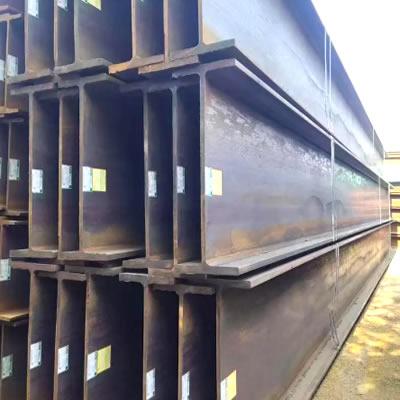
H-beam is an economical and efficient profile with a more optimized cross-sectional area distribution and a more reasonable strength-to-weight ratio. It is named after its cross-section, which resembles the English letter "H". Due to the right-angle arrangement of all parts of the H-beam, it possesses advantages such as strong bending resistance in all directions, simple construction, cost savings, and lightweight structure, making it widely used.
The flanges of H-beam are parallel or nearly parallel on both the inner and outer sides, and the ends of the flanges are at right angles, hence the name "parallel flange I-beam". The web thickness of H-beam is smaller than that of ordinary I-beams with the same web height, while the flange width is larger, thus it is also known as "wide flange I-beam". Due to its shape, the section modulus, moment of inertia, and corresponding strength of H-beam are significantly better than those of ordinary I-beams with the same unit weight. When used in metal structures with different requirements, whether it is to withstand bending moments, pressure loads, or eccentric loads, it demonstrates its superior performance, greatly improving the load-bearing capacity compared to ordinary I-beams and saving 10% to 40% of metal. H-beam has wide flanges, thin webs, multiple specifications, and flexible use. When used in various truss structures, it can save 15% to 20% of metal. Due to its parallel flanges on both the inner and outer sides and right-angle ends, it is easy to assemble and combine into various components, thus saving about 25% of welding and riveting work. It can greatly accelerate the construction speed and shorten the construction period.
There are many product specifications for H-beams, and they can be classified in several ways. (1) According to the flange width of the product, H-beams are divided into wide flange, medium flange, and narrow flange H-beams. The flange width B of wide flange and medium flange H-beams is greater than or equal to the web height H. The flange width B of narrow flange H-beams is approximately equal to half of the web height H. (2) According to the product usage, H-beams are divided into H-beam girders, H-beam columns, H-beam piles, and extremely thick flange H-beam girders. Sometimes, parallel leg channels and parallel flange T-beams are also included in the scope of H-beams. Generally, narrow flange H-beams are used as beam materials, while wide flange H-beams are used as column materials. Based on this, they are also referred to as beam-type H-beams and column-type H-beams. (3) According to the production method, H-beams are divided into welded H-beams and rolled H-beams. (4) According to the size and specification, H-beams are divided into large, medium, and small sizes. Products with a web height H above 700mm are usually referred to as large size, those between 300-700mm as medium size, and those below 300mm as small size. By the end of 1990, the world's largest H-beam had a web height of 1200mm and a flange width of 530mm.
Internationally, product standards for H-beam steel are divided into two major systems: the imperial system and the metric system. Countries such as the United States and the United Kingdom adopt the imperial system, while China, Japan, Germany, Russia, and other countries adopt the metric system. Despite the use of different units of measurement in the imperial and metric systems, the specifications of H-beam steel are mostly expressed using four dimensions: web height h, flange width b, web thickness d, and flange thickness t. Although countries around the world have different methods of expressing the dimensions and specifications of H-beam steel, the range of product dimensions and dimensional tolerances produced are not significantly different.
Previous:channel steel
Next :I-beam